
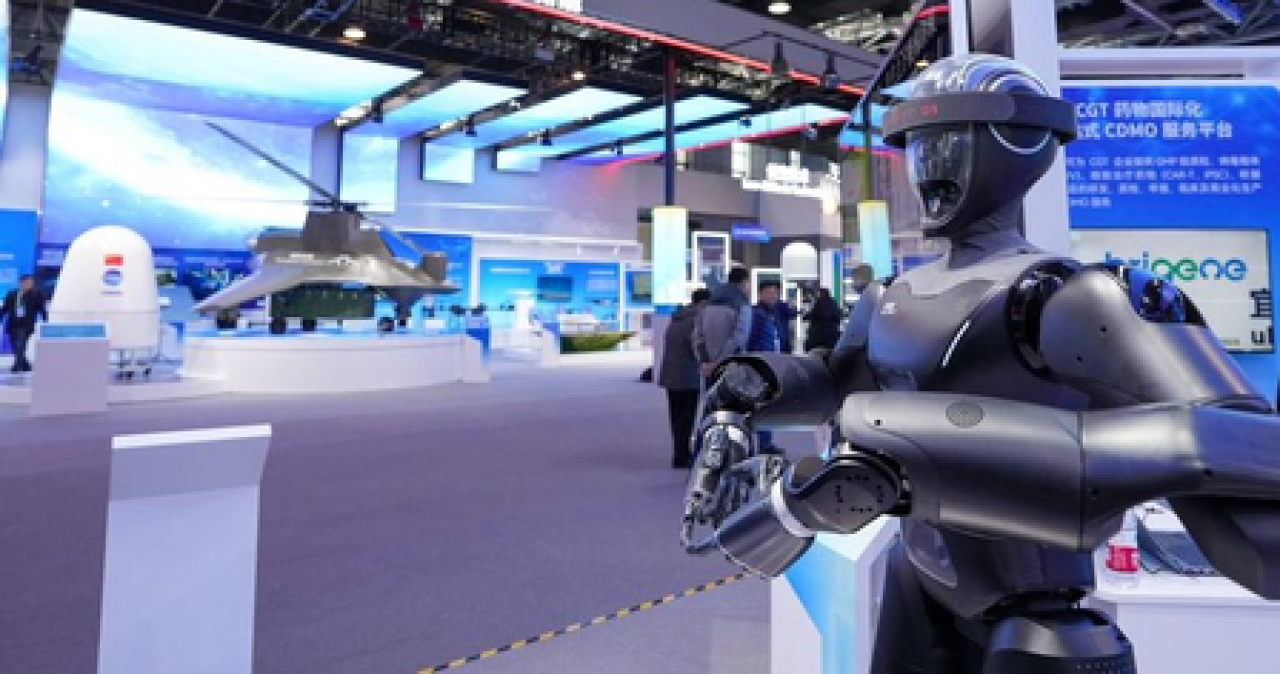
Washington, March 18: American lawmakers and industry experts have raised alarms over China‘s advancements in artificial intelligence (AI), robotics, and autonomous systems, deeming them a growing national security threat. The concerns encompass issues related to data access, cyber vulnerabilities, supply chain dependencies, and military applications.
During a hearing of the House Homeland Security Subcommittee, Chairman Andrew Garbarino stated that this challenge is now emerging “within the United States.” He emphasized that the People’s Republic of China is “aggressively trying to dominate technologies that are transforming the global economy and security, including artificial intelligence, robotics, and autonomous systems.”
Garbarino specifically mentioned the Chinese AI company DeepMind and the robotics firm Unitree. He noted that DeepMind released a model in January 2025 that matched top American systems, at a cost reported to be only a fraction of American companies’ investments, sparking market disruption and leading some to label it an “AI Sputnik Moment.”
The real concern, he pointed out, is that DeepMind may have incorporated outputs from leading American AI systems into its training, effectively engaging in illegal reverse engineering of capabilities developed through legitimate investments. He accused, “DeepMind did not just compete; according to these revelations, it stole from American companies.”
He also warned that the company’s app is available on the Apple App Store, and “every interaction is stored on servers located in China, where authorities can demand access to that data.”
Industry and policy experts are calling for a tougher stance from the U.S. Max Finkel from Scale AI remarked that while the U.S. leads in aspects measured by Washington—models and chips—it lags in areas that will determine the future, namely data and its utilization. He stated that China currently holds “about 90 percent of the commercially available robotics AI data market” and is investing significantly more in this sector.
Matthew Molchanov from Boston Dynamics emphasized that robotics should be a top policy priority, as advanced robots represent the “physical form of AI.” He cautioned that if manipulated, robots could pose greater dangers than standard connected devices. “Attackers could disrupt production lines or halt security patrols,” he warned.
Michael Robbins from the Association for Uncrewed Vehicle Systems International noted that the U.S. has seen similar patterns with drones in the past. He alleged that China is attempting to undermine the American robotics industrial base and establish Trojan horses within critical infrastructure.
Rush Doshi from the Council on Foreign Relations indicated that China’s progress has been faster than anticipated. “In 2024, Chinese factories deployed nearly 300,000 new industrial robots, while American factories installed 30,000,” he highlighted.
He also warned that Chinese laws pose espionage risks, as companies may be compelled to cooperate with state intelligence agencies. Ranking member Representative Eric Swalwell expressed concerns about China’s technological competition while also criticizing the Trump administration’s cuts to agencies like CISA, the National Science Foundation, and NIST, which he claimed weakened America’s defenses at a time when technological competition is intensifying.
Experts supported a ban on the procurement of Chinese technologies in sensitive federal areas. When Garbarino inquired whether Congress should consider measures similar to those imposed on companies like Huawei or DJI, all panelists agreed.
In recent years, Congress and several administrations have increased scrutiny and restrictions on Chinese telecom equipment, drones, semiconductor exports, and connected vehicles.