
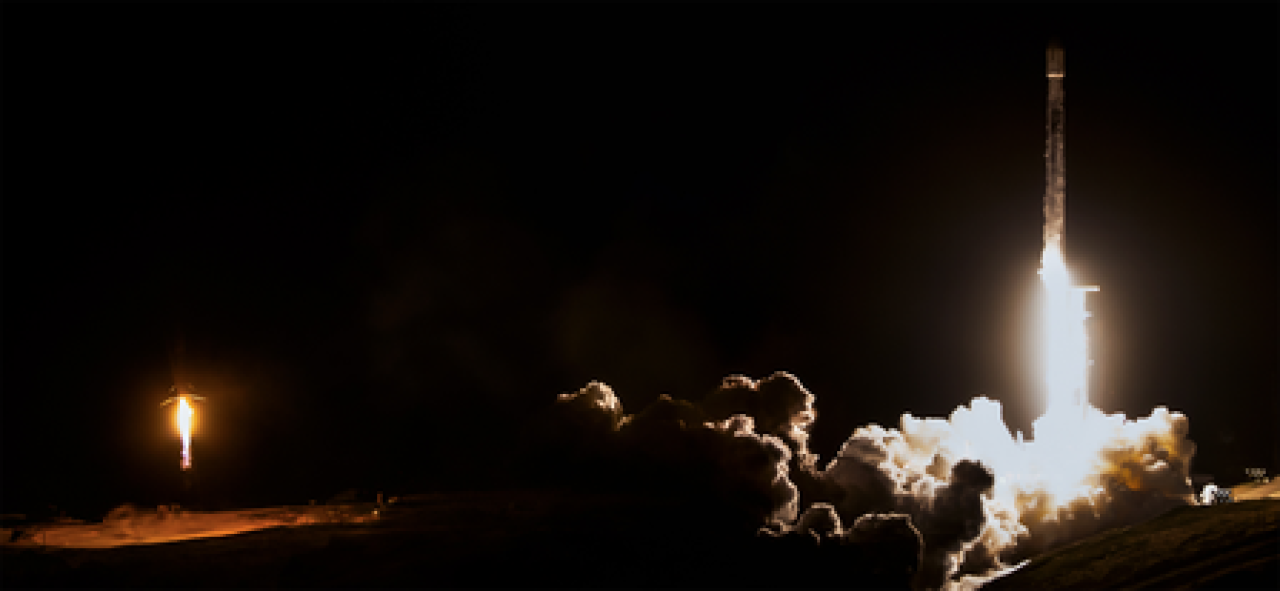
Bengaluru, May 3: The Indian Space Association announced on Sunday that the successful launch of Mission Drishti serves as a decisive testament to the reforms in India’s private space sector. This marks a significant step towards all-weather Earth monitoring from space.
Lieutenant General (Retd) A.K. Bhatt, Director General of the industry body, stated that this achievement reflects a major shift in India’s approach to Earth observation from space and highlights the growing maturity of the private space ecosystem.
He emphasized that the mission demonstrates the capability of private companies to develop critical technologies used in national security and disaster relief. The successful launch of GalaxyI’s first satellite under Mission Drishti, which is also the largest satellite ever built by an Indian private company, symbolizes a significant change in India’s perspective on Earth observation.
Bhatt further noted, “This is a decisive proof of the reforms in India’s private space sector and indicates a move towards crucial sovereign, all-weather monitoring capabilities for national security and disaster relief from small-scale testing.”
This statement follows the successful launch of Bengaluru-based startup GalaxyI’s first commercial satellite, Mission Drishti, which is reported to be the world’s first OptoSAR satellite.
The launch signifies a significant advancement in Earth observation technologies and strengthens India’s growing capabilities in the global space sector. Weighing approximately 190 kilograms, Mission Drishti is the largest Earth observation satellite developed privately in India.
It is the world’s first satellite to integrate electro-optical (EO) and synthetic aperture radar (SAR) sensors on a single platform, enabling imaging in all weather conditions, day and night.
Highlighting the technical success, Bhatt stated that with the commercialization of OptoSAR, GalaxyI has achieved a milestone that only a few global companies have reached. It is capable of seamlessly integrating optical and radar capabilities for continuous, all-weather information retrieval. Its significance lies not only in the technology but also in its broad impact on applications that define value in the space economy, particularly in Earth observation, where timely and actionable information is crucial.