
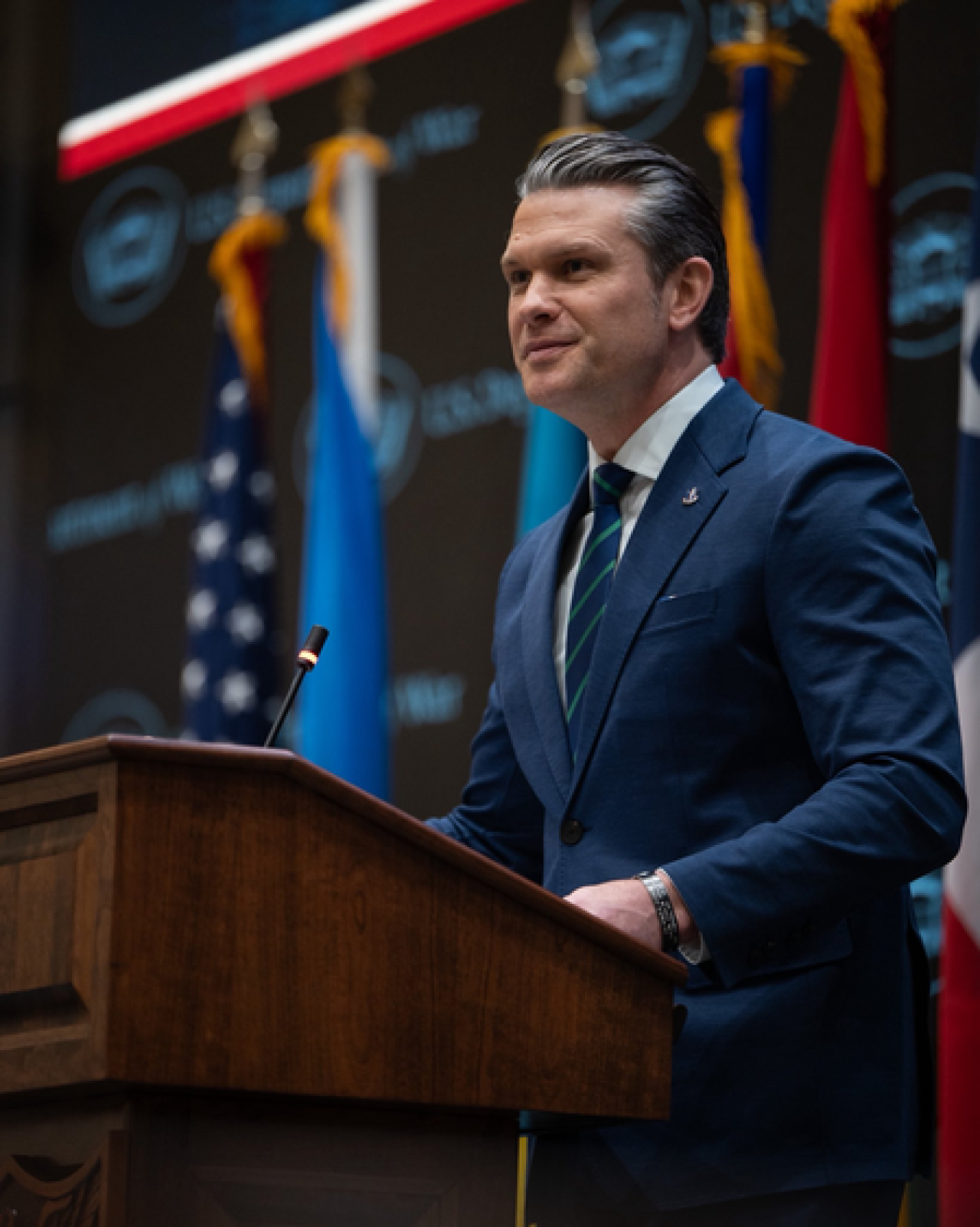
Washington, April 24: The United States has announced that its increasing naval blockade against Iran is tightening by the hour. Defense Secretary Pete Hegseth claimed that Iran now faces two options: either to negotiate a nuclear deal or to endure a significant economic crisis due to ongoing American pressure.
Speaking to reporters at the Pentagon, Hegseth stated that “Operation Epic Fury” has yielded decisive military results within weeks, distinguishing it from prolonged and inconclusive wars of the past that lasted for years or decades.
He explained that the US Navy is enforcing a strict blockade from the Gulf of Oman to international waters, warning that any vessel found violating the rules will be sent back. Currently, 34 non-Iranian ships have been granted passage, with several already having crossed. Hegseth mentioned that another aircraft carrier will join the operation in the coming days.
Chairman of the Joint Chiefs of Staff, Air Force General Dan Ken, noted that the US military has already demonstrated its capability to use force when necessary. He recounted an incident this week where a large container ship ignored repeated warnings, leading Central Command to authorize fire on the ship’s engine room, after which Marines secured the vessel and its crew, now safely under US control.
The Pentagon also reported that Iran’s restricted oil shipments have been intercepted in various parts of the world, including major oil tankers in the Indo-Pacific and Indian Ocean regions. General Ken stated that such maritime interdiction operations will continue.
Hegseth emphasized that the blockade is expanding globally, asserting that no vessel can pass through the Strait of Hormuz without US Navy permission. He accused Iran’s Revolutionary Guards of acting like “pirates” and attacking commercial ships, contributing to regional instability.
The US has also authorized action against Iranian fast boats laying mines at sea. Hegseth warned that if Iran places mines in the water, they will be destroyed without hesitation. He urged allied nations, particularly in Europe, to take a more active role in securing maritime trade routes, stating that the time for free-riding is over, as Europe and Asia heavily depend on oil passing through the Strait of Hormuz.
Referring to Donald Trump, Hegseth mentioned that the President is not keen on a deal, but if Iran abandons its nuclear program in a genuine and verifiable manner, the possibility for negotiations remains open. General Ken added that the US military is prepared for any major military operation, as conditions are rapidly changing.
This development comes amid heightened tensions in the Gulf region, where the Strait of Hormuz is a crucial route for global oil trade, and any disruption could significantly impact energy markets and trade worldwide.